Friday, October 26, 2012

FASHION...Everything New is Old - ALWAYS!


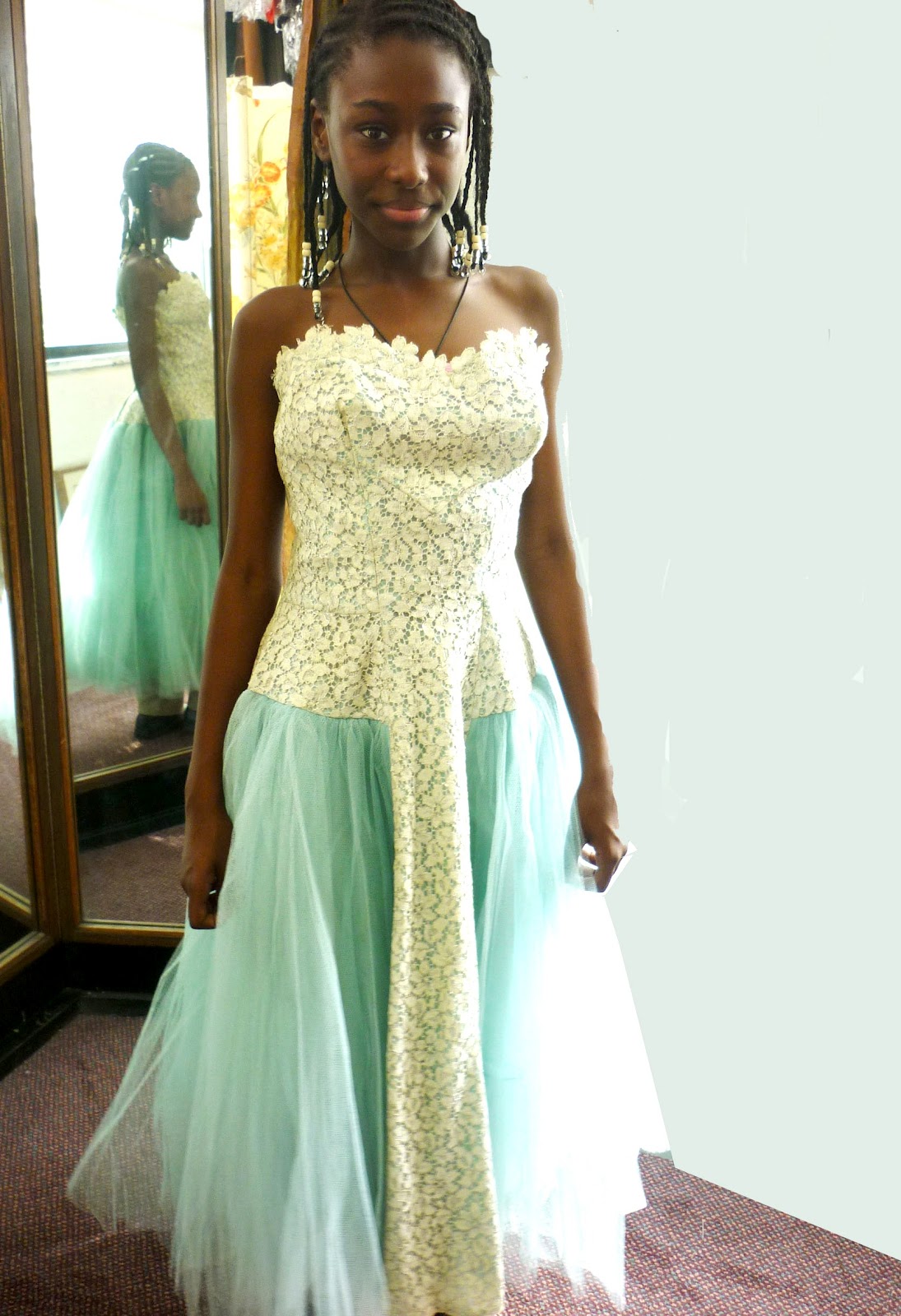
Ceci in her 1940 garb

Our lovely intern Ceci Cholst was inspired by  the process our well-known (and anonymous!) fashion designer clients go through, leafing through our vintage inventory in search of inspiration for their next collections! 

great shoulder detail
Below, Ceci, in her own words, talks about the experience of helping the clients as well as picking out some of her personal favorite prints and dress details in the process. She calls her piece "One Dress, Many  Directions"

Recently, Helen Uffner Vintage Clothing welcomed two very different fashion designers (whom we shall call “A” and “B”) in search of renting some Fall 2013 inspiration. As a current intern and aspiring fashion designer, yours truly was very excited to guide these big-name designers through our massive vintage collection and watch the birth of next season’s trends happen before her very eyes! Even better was finding out that the new fall trends stem from my favorite era: the 1930s! Both wacky and serious, the 1930s offers simple, flattering silhouettes that are easy to manufacture with a wide range of clever prints and design details that would make any designer’s imagination run wild.

Ceci's dress find!
“A” came in seeking monochromatic, faded floral prints with a touch of whimsy to match the brand aesthetic. I had the distinct pleasure of helping A’s team comb through our 20s, 30s, and 40s dresses. While searching the 1930s dress rack, I happened on a beautiful salmon pink dress with a wilting daisy print. It had pintucks along the bust, typical of the mid-30s, and faux pockets trimmed with little bows. It was innocent but not saccharine, beautiful with a dash of melancholy. I found yet a few more dresses with a similar print (one wonders if it was a mini trend—a topic for another post, perhaps?), and also showed them to A.

close-up detail of shoulder
Fabulous collar and cuff details..AND  buttons!
These dresses were unlike anything A had pulled: most of the prints A’s team chose were quirky white flowers on a crowded field. The daisy dresses literally made A stop short and reconsider their previous selections. In the end, A did not take the pink dress but chose to rent instead a mint green daisy print shirtwaist dress with matching daisy buttons. I can’t help but speculate that  this dress will help A’s design team go in a totally different direction and transform their collection, or the team might edit it out once the samples return and realizes the print doesn’t fit, no matter how much they love it. Either way, it was interesting to witness the moment a designer challenges their initial vision and comes away considering totally different alternatives!


love the buttoned yoke
A few days later, “B” came in, seeking classic 1930s and 1940s dresses and suits for inspiration (think more Hollywood glamour, less Art Deco) ranging from muted pastels, browns, and blacks to rich jewel tones as part of the color story. Together, we pulled some fantastic florals, amazing deep purple suits, and even a sheer 1920s black floral chiffon gown. This designer was more color-oriented than A and also more specific in their period references, but even within those narrower parameters, it was still too difficult to choose among the hundreds of elegantly tailored dresses HUVC boasts!

Knowing that my pink daisy dress actually fit in B’s color story, I eagerly brought it out again. The dress immediately won B over: B explained that the design team preferred floral prints that were distinctly “American”: rounded flowers and lots of empty space. Ultimately B picked other pieces for an initial presentation to the team, but felt the pink dress I offered was a strong contender and wanted to come back for it later.
a wow collar!
great  30's collar and crepe combo
Where A wanted 1930s quirk, B wanted 1930s cool. It was an eye-opening experience to see how, despite one decade’s very divergent design impulses, the same dress appealed to disparate tastes. This little pink dress, more than anything, tells the story of the fall 2013 girl.


Wednesday, August 15, 2012

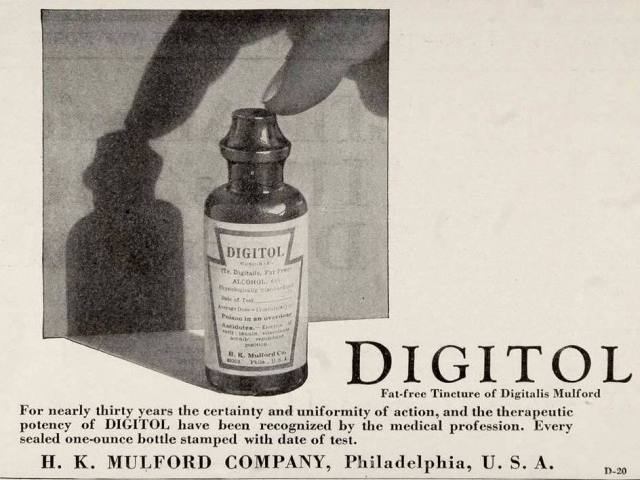
THE CURIOUS TALE OF A POISONOUS ANTIQUE DRUGGIST BOTTLE

We recently came across an old pharmacy prescription bottle (and we mean OLD!) for Tincture of Digitalis. Inside were little brown pellets, not unlike, ahem, tiny mouse droppings.

The bottle was stamped Owens on the bottom, which had been making prescription bottles since at least the early 1900s.
British bottle
DIGITALIS? Wasn't that a lethal, plant-based poison known to be used to plan Victorian murders in old novels? 

The British bottle on the right reads:  To be taken twice or thrice daily, with a little water after food. To be taken with great Caution ( with a capital "C"!) 


Apparently there were many kinds of digitalis tinctures available at the time, which were used to control both the heart rate and sometimes epilepsy, and  was discussed in a late 1700's English medical journal.

Drawing of a digitalis plant
Digitalis is a drug extracted from the foxglove plant, often used by herbalists. It is said that Native Americans brewed the dried leaves to treat leg swelling and that as early as the 1400's, it was often used to cleanse wounds.

An interesting fact is that this scientific name means "finger-like", perhaps because each of these little tubular innocent flowers can fit over a human fingertip.

foxglove flowers
Alas, the often dangerous side-effects led to calling this plant by other names, such as "dead man’s bells" and "witch's gloves".

The entire plant, including the root and the seeds is toxic: some side effects can be delirium and hallucinations, such as seeing halos around objects. Children have even been known to die drinking the water from a digitalis floral plant in a vase.


In researching this apparently dangerous drug, we came across some quirky digitalis labels: for instance, just in case you wanted to be poisoned but were dieting at the time, you have this label, FAT-FREE Digitalis!!


More recently, very low doses of digoxin, the active ingredient derived from digitalis, have been re-purposed to treat high blood pressure patients...(just tellin' ya!)..


..but here, on the label,  is a recipe for the antidote: "Strong coffee without milk or sugar, after which, to produce vomiting, mustard mixed in warm water, or grease in warm water: stimulants when necessary; keep body in reclining position"

As an aside, the address printed on our bottle's label is 1800 West 11th Street, Los Angeles California and the two phone numbers printed on the side read  "Federal 6050" and "Drexel 9578."  

....when was the last time you saw  a 4-digit phone number? After doing a bit of research we learned that it was only after World War II that DRexel, FEderal and several other exchanges were changed to DUnkirk followed by a five-digit number.

..and here is another interesting old druggist bottle. Who knew?


Tuesday, June 19, 2012

CAN WE TRY ON BEYONCE'S SHOES? 7th and 8th graders tour HUVC..and recent project updates!!


Every so often, we are contacted to give tours of our vast costume collection. Usually they are for university classes, tour groups and charity auction winners but this one was for kids, so it was especially fun! 

The middle school Fashion Class of the WCSS Charter School in Williamsburg, Brooklyn came May 30th, the 7th and 8th graders eager to try on vintage garments, hats and shoes!!!!

Once it was disclosed that we had several of Beyonce's clothes and shoes from her film "Cadillac Records", all chaos broke loose as they each insisted on taking turns trying them on!
 
These students have apparently all  learned how to sew from their teacher, Monique (who happens to have a side business making cupcakes and cakes for special occasions - even purse-shaped ones!) http://www.moniquesuniquecakes.com/

 Helen took the girls on a complete tour with the help of our intern Nelly, and explained the different styles through the ages.
 
Below Helen shows the students Victorian clothing and explains how the interiors were boned and women had to wear corsets and multiple layers of undergarments under these dresses.


Here, a lovely young lady tries on a flocked velvet mid-1800's coat often called a "mantle"


 We encouraged the students to try on items they fancied so, here, " Watch out...George Washington in the house!!!"


The tour continued through the different decades as we talked about the different movie projects we worked on and showed the stars' original clothes.


We examined period undergarments.
 We looked at men's wool bathingsuits ( the general consensus was "You're kidding, right!!!!!!??? Wool?)

BUT....it appeared that vintage shoes, Beyonce's or not, were the stars!
some fit

...and some did NOT!!!


The other favorite try-ons were a series of what the students called "fairytale dresses", poufy 1950's gowns that they vowed to come back to rent for their proms, years hence!


 All in all, a fun time was had by all! They even learned to pose with attitude! Below, "Ready for my close-up, Mr. DeMille!"


Teacher Monique brought us treats
Her own hand-made cupcakes!


-----------------------------------------------------------------------------------------------------
 In other news, catch that wonderful film "MOONRISE KINGDOM"!! Below you see our boys' vintage sweaters lined up in a row and below, the sweaters as they appeared in the film!


Other recent projects are:

MEN IN BLACK 3: We supplied the clothes in the store windows as well as the nutty clothes for Aliens trying to "fit in" to the 1970's scene!


JIMMY FALLON'S DOWNTON ABBEY SPOOF CALLED "DOWNTON SIXBEY": we supplied Brooke Shield's dress, among other things.

30 ROCK EPISODE: a flashback when Liz Lemon goes back in time to when she was making a nuisance of herself when her parents wanted some romantic privacy!

JAMES FRANCO'S BIO-PIC FILM "BROKEN TOWER", RECENTLY RELEASED:

ON BROADWAY, WE WORKED ON THE POSTER FOR "NICE WORK IF YOU CAN GET IT" ( they illustrated the poster from our clothes):
and...OUR CLOTHES ALSO APPEARED ON BROADWAY IN  "LOOK BACK IN ANGER"..HERE IS OUR ROBE:


FINALLY.....IT IS THE BEGINNING OF SUMMER so a big hello from our staffers Masha, Dan and Julia ready in their oversize 1940's sun hat finery!!!!!!! 

Friday, May 18, 2012

OFF ON A TANGENT: SILK LINGERIE TO CORTICELLI THREAD TO SILKWORMS - A HISTORY


Our 1920s silk lingerie pattern
We came across this wonderful 1920’s pattern for silk undergarments and wondered about the origin of the Corticelli Silk Company with its cute kitty logo in the upper right-hand corner.

Mr. Whitmarsh
In researching silk production and the original of the company, we came cross a gentleman named Samuel Whitmarsh, who in 1832 moved to Northampton, Massachusetts to plant 25 acres of mulberry trees and a set up a cocoonery on his estate to create a silk mill. It became a great tourist attraction.

What? Mulberry trees? What do they have to do with silk?  A lot!!! Apparently though there are many varieties of mulberry trees (Japan has about 700 kinds!), silkworms only eat the leaves of white mulberry trees.

silkworm moth
Silk moths lay their eggs on the mulberry leaves and 14 days later, the worms hatch and feed continuously on the leaves, molting as they grow. After molting 4 times, the larvae enclose themselves in a raw silk cocoon produced by their own salivary glands. Did you know that silk is basically a protein? 

cocoons
In its cocoon, the silkworm transforms into a pupa that eventually emerges as a moth in about 3 weeks.  The moths reproduce and though they die within 5 days, the female manages to lays between 200 to 500 eggs (!!!) within that time to again continue their cycle of life.

Silk is created by dipping cocoons in boiling water to kill the pupa and unraveling the thread. Each cocoon is actually a single thread that ranges from 300 to 900 meters long. Amazing, right?


Another interesting fact is that mulberry trees have such other diverse uses: the leaves are used as feed for pigs and chickens; ethanol is created from mulberry tree sawdust; it is used as traditional folk remedy for everything from asthma to diarrhea to epilepsy to tumors;  the twigs are used for making baskets; the wood is used for furniture and a traditional Japanese tea ceremony green tea scoop called “Cashaku” is made of mulberry wood.

Noguchi Shoji lamp
American Samoa Tapa cloth
Famed sculptor Isamu Noguchi used boiled mulberry tree bark to create his “Shoji” paper lamps and in Polynesia, it is used to make a fabric called “Tapa cloth”.

Big timber companies have tried to take over  viable land that produce these trees, but tribes such as the Maisin people of Papua New Guinea have rejected offer to sell their one million acres of ancestral rain forest, trying to make their living in part by selling these Tapa cloths from mulberry trees grown in their own gardens.

…..and now, back to Mr. Whitmarsh, who was advocating the sale of mulberry trees to the public. Alas by the end of the decade, “mulberry speculation” crashed, along with Mr. Whitmarsh’s dreams. 

Members of the Utopian Association
Book about their Society

In 1842, members of a local Abolitionist group calling themselves the  Northampton Association of Education and Industry established a utopian community and took over the silk mill as their main source of shared income,  community owned and operated. They believed that the rights of all should be "equal without distinction of sex, color or condition, sect or religion." Famed freed slave and activist/orator Soujourner Truth was a member of this group, and though the utopian community dissolved in 1846, she continued to live in the area until 1857.

Sojourner Truth

Mr. Samuel Lapham Hill
Another of the original members who strove to create a humane industrial society was Mr. Samuel Lapham Hill, whose home in Florence, Ma. was used as a stop for the Underground Railway to spirit former slaves to safety. Mr. Hill also established Americas’ first free kindergarten called the Hill Institute.

At the time, the newly invented sewing machine made its appearance but one of the inherent problems was the unevenness of the threads used. Hill devised a machine that could spin smoother thread and submitted it for approval in 1852 to Mr. Isaac Singer…who was so delighted with the smooth quality he explained “ I shall want all you can make!”


This new “fabric became known as “machine twist” …and within 20 years, his company became the largest silk thread manufacturer in the country.

When the commune dissolved, Hill took over the factory and called it the Nonotuck Silk Factory, which later merged with the Corticello Silk Company, which became the world’s largest producer of silk thread made with raw silk imported from Japan.

The famous Corticelli Silk Thread Company logo was the “Corticelli Kitten” a kitten playing with a spool of thread, and between 1910 and 1913, a huge electrical sign loomed over Broadway in NYC with their logo, one of the earliest ads on the Great White Way.
One of Broadway's First Electric Advertising Signs